
Hardware information
-
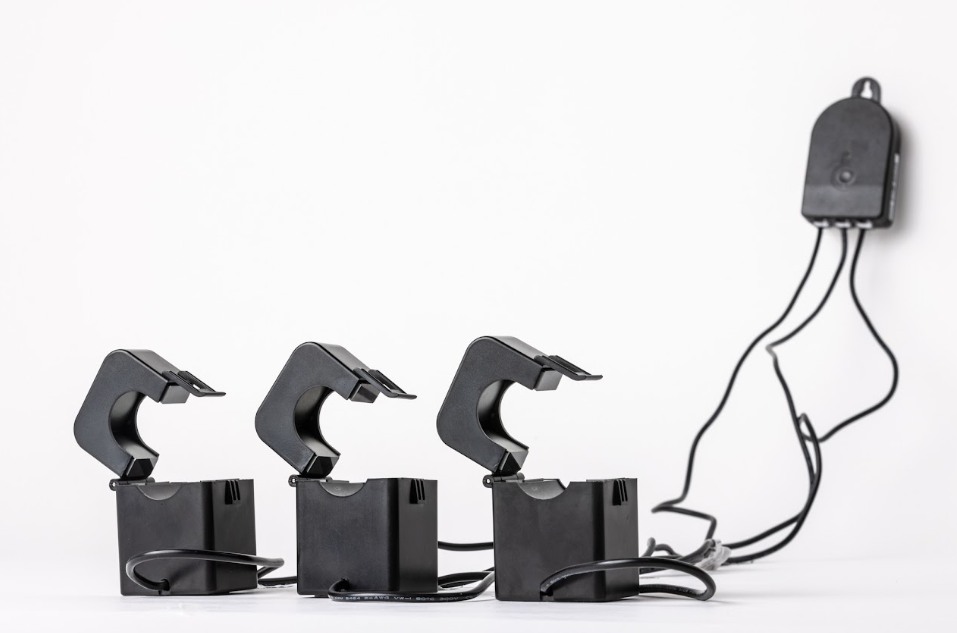
Wireless transmitter: The central unit that sends data to the bridge.
-
Current clamps:
-
3-Phase: 3 clamps (clips around L1, L2, L3)
-
-
-
1-Phase: 1 clamp (clips around the phase cable).
-
Technical specifications
Sensor configurations: Select the correct sensor configuration based on your machine's power supply:
-
3-Phase Sensors: Standard for most industrial machines. Consists of 3 clamps and 1 transmitter.
-
1-Phase Sensors: Used for smaller machines or specific sub-components. Consists of 1 clamp and 1 transmitter.
Sizing guide: Sensors must be matched to the Fused Power (Amps) and the Cable Diameter of the machine.
| Size | Range (Amps) | Best for... |
| Small | 0 - 60A | Light machinery, fans, pumps |
| Medium | 60 - 200A | Standard production lines, conveyors |
| Large | 200 - 600A | Heavy machinery, main feeds |
| XL | 600A - 3000A | (Flexible coils) Main incomers |
Note: Submit your requirements via the Technical Assessment to ensure you receive the correct hardware.
Measurement logic
-
Sampling: The sensor conducts 2 measuring cycles, lasting 30 seconds each.
-
Granularity: The system calculates the average of these cycles and transmits data at a 1-minute interval to the software.
For detailed electrical ratings and physical dimensions, consult the technical data sheets:
-
Standard sensors (60A - 600A): Click here.
-
Flexible sensors (600A+): Click here. For more information, go to this article.
Technical troubleshooting
Inaccurate readings
-
Check clamp closure: Ensure the clamp is fully clicked shut around the cable. A partial gap results in low or zero readings.
-
Verify sizing: Using a large sensor on a very low-amperage cable (e.g., a 600A sensor on a 5A load) can reduce accuracy.
No connection
-
Check distance: Ensure the sensor is within 10 meters of the bridge with no obstacles in the way — walls, big machines, metal fencing, cabinets, etc. — or check that there’s roughly one bridge per 5 sensors in the area.
-
Check shielding: Do not place the transmitter inside a fully closed metal cabinet unless the bridge is also inside the same cabinet. Metal blocks the wireless signal.